

Objects in the conditional tense
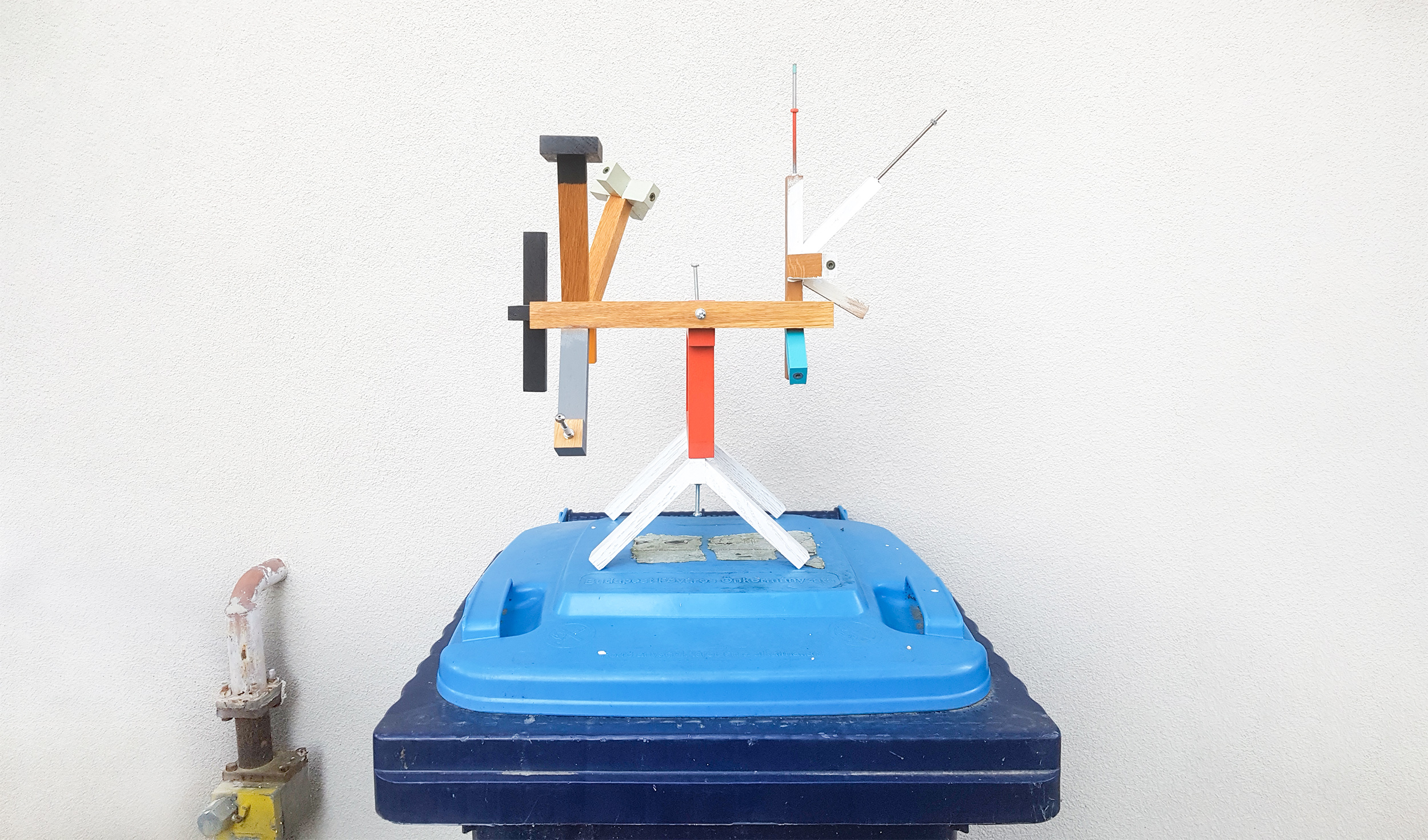
“Objects in the conditional tense” – this phrase came to mind when I read together the enigmatic title of Ádám Kokesch’s exhibition and the works on display. The objects appear in the space as statements that call themselves into question. They are intermediate beings, always interpreted within a particular network of relationships: their individual details are familiar, yet taken as wholes they remain unfamiliar. Kokesch’s objects – and the exhibitions constructed from them – reveal relations and correlations. They construct alternative worlds and realities from fragments of the material world. The objects slip away from the obvious practice of identifying things through language. What we see is not a model, but something that could be a model; not a sensor, but something that could be a sensor; not a solar panel, but something that could be a solar panel. One might call it a simulation, but it would be more accurate to say that it could be a simulation, because it does not simulate everyday material reality. Rather, it builds from its details and fragments an alternative semantic system with its own syntax.
An important aspect of this syntax is the reuse of ready-made elements – the practice of recycling – which has both economic and intellectual dimensions. Kokesch constructs new constellations from fragments of everyday material culture that seem worthless, sometimes even identifiable as waste. His art reflects the contemporary culture of recycling, into which not only objects but also references are incorporated: ready-made topoi, clichés, patterns, and formulas. The fundamental case of recycling in art is the ready-made and the objet trouvé – the found object declared to be art – from which object collages and assemblages may emerge, such as Schwitters’s Merz works or Tatlin’s counter-reliefs. Kokesch recycles not only fragments and debris of objects but also the very practices of recycling, from Dadaism through Surrealism and Pop Art to Neo-Geo. In doing so, he recalls the commonplace tropes of geometric abstraction, which have by now become embedded in everyday object culture and design – from Kazimir Malevich to Piet Mondrian and László Moholy-Nagy, from Frank Stella to Donald Judd and Imi Knoebel, from Joseph Cornell to Andreas Slominski and Tomás Saraceno, as well as Dóra Maurer; from Suprematism to De Stijl and the Bauhaus, and onward to Hard Edge painting, shaped canvases, minimal art’s reconsideration of industrial form, and finally to the post-geometric, post-industrial, and post-digital currents of abstraction. Kokesch, however, does not integrate industrial design itself into his art so much as the effects of industrial design. His works are always handmade, scaled to the human body, and thus also build upon the beauty and aesthetics of the contingencies and small imperfections that arise from manual craftsmanship (techné). They evoke a kind of DIY aesthetic, bearing the euphoria of free play, the intellectual freedom contained within the notion of bricolage, and the stylistic and semantic flexibility that results from placing ready-made tropes alongside one another. This flexibility need not necessarily be understood in terms of the postmodern proliferation of art historical quotations or the practices of post-production and sampling.
Far more important, I believe, is the concept of play itself, and the freedom of the individual who retreats into the garage and experiences independence through making and experimenting – the liberating potential inherent in constructing alternative worlds and realities. Kokesch’s objects, however, are not simply DIY artifacts. Rather, they reproduce the patterns of the high-tech world using the means of handicraft and other traditional artistic techniques. One such technique is Hinterglasmalerei (reverse glass painting), which has become the artist’s trademark. It enters into a curious interaction with the visual effects of recycled plexiglass sheets and lenticular surfaces. Ultimately, what we see is painting that extends the traditions of geometric abstraction, while at the same time object art that relocates the format of the objet trouvé into a new context, organizing itself into a total installation within the exhibition space. This raises the question: where does painting belong, and what is its fate within technological civilization? More broadly, what role do manually created objects and images still play in industrial and post-industrial societies?
Kokesch does not provide answers – he asks questions. Within the space of a Kokesch exhibition, we feel strangely at home. He furnishes and inhabits the exhibition spaces; his objects occupy their places without intrusion, standing in the middle of the room or hiding in its more secluded corners. They do so much like the objects of technological civilization and design culture: tables and lamps that serve human comfort and create the conditions for work; solar panels that promise the most efficient and environmentally friendly means of generating energy; cameras and sensors that monitor every movement of the subject and ultimately function as instruments of surveillance. Kokesch’s objects do not observe the viewer in the exhibition space; rather, they observe the very act of mechanized observation itself. To this extent, can they be understood as critiques of mass-produced consumer goods, the flood of gadgets that surrounds us, or, more broadly, of surveillance capitalism?
Several interpreters have already described Kokesch’s objects as hybrid. Indeed, hybridity and hybridization are central features of his artistic practice. Everyday objects merge into new objects, and in the process, they lose their original identities. Can we speak, in this context, of the metamorphosis of the cliché? Or perhaps more accurately, of the exposure of the cliché as cliché? Or even of commonplace elements unexpectedly connected to one another, reorganizing themselves into revelatory propositions? Yet Kokesch does not make assertions; instead, he speaks in the conditional tense. As several commentators have noted, he creates mechanisms that enact and reproduce the very process of meaning-making. Paradoxically, these mechanisms derive their usefulness precisely from their uselessness. The tautology of a self-illuminating object exposes the futility of the seemingly self-evident, ready-to-hand objects we habitually use – in Heidegger’s sense – revealing the uselessness of the unnecessary, mass-produced objects that populate our world.
The surfaces of his small-scale sculptural works sometimes resemble panel paintings. Tiny imperfections, wavering hand-drawn lines, irregular scribbles, and the accidental flow of paint all display unmistakably painterly qualities. The cross and the rectangle, as tropes of geometric abstraction and as clichés reduced to mere design elements, acquire new significance as the basic vocabulary of a visual sign language, as elementary components of a tautological formula. They become the central motifs of pictograms and emblems that point nowhere and to nothing – and are therefore tautological once again. The same applies to his collages, which reorganize and recycle the incidental materials of everyday object culture, for example packaging. Packaging exists to protect an object and to make it marketable. Kokesch transforms the packaging itself into the object.
As I have already suggested, Kokesch’s works are hybrids. Hybridity implies, in some sense, the relinquishing of fixed identity or the formulation of more fluid identities. His objects possess no stable identity, no function; his packages bear no brand names. They are signposts without directions.
Kokesch’s fragile, intimate, small-scale works are complemented by larger, more monumental yet surprisingly airy constructions. These constellations of objects resemble stage sets that openly reveal themselves to be stage sets. A pedestal may become a table, almost an operating table, a laboratory workbench, or the display case of a Wunderkammer from the world of science fiction.
Beginning from the corners of a surface, Kokesch constructs a framework, tracing the contours of a cube and creating a space within space. He establishes his own field of play, illuminated by a cold neon light. Floating at the center of this space is a skeletal structure – almost a model, almost a maquette, almost a skeleton, almost a stylized animal, almost a demonstrative model of molecular structures, almost a child’s toy, almost a post- or neo-constructivist object, almost a ship, almost an airplane. It is all of these things and none of them. Both literally and metaphorically, it is a flexible structure: its arms and appendages can be moved, its elements adjusted and reshaped. The construction resembles a toy that invites the viewer to play. The object encourages not only the manipulation of its movable parts but also the free play of associations. It invites us to relive the freedom experienced by the tinkering subject in the garage – to recreate small spaces of freedom within our own imagination.
It is tempting to think of this structure as a fragile utopia, a kind of model of the world – or, borrowing the title of Kokesch’s collected volume, as a world game. Indeed, one senses within it an interest in both microcosmic and macrocosmic structures, as well as in the psychological dimensions of childhood play and a desire to explore the individual and collective unconscious.
Kokesch’s works are analytical insofar as they are built upon the decomposition of things into their constituent parts. Yet an equally important characteristic is their synthetic quality: the search for a dynamic equilibrium created from elements that do not naturally belong together. They strive to suspend both function and meaning. At times, this suspension can also be understood in the literal, physical sense. Kokesch seeks the aesthetics of hovering in the space between the tangible and the intangible. He searches for beauty without aestheticizing. The apparent sterility of the high-tech world is paired with the rawness of a DIY aesthetic, with scratches, scribbles, and irregularities. His works are characterized by a perfectionism that constantly questions and undermines itself. Doubt, it seems to me, is one of the defining features of Kokesch’s art. The function, identity, destiny, and physical and conceptual place of his objects all remain uncertain.
All of this brings us back to the exhibition’s enigmatic title, which refers to Lindsay Anderson’s 1968 film If…. Through its portrayal of the hierarchical, oppressive world of a British boarding school, Anderson’s film confronted, at a particular historical moment, the dilemmas of humiliation, the possible responses to oppression, and the possibility of rebellion. The enclosed world of the school functions as a model, reflecting broader social structures beyond itself.
When Kokesch creates models and constellations of objects, he, too, constructs structures and models. He dismantles systems and builds new ones. For him, this is neither more nor less than an exploration of the limited field of play available to him. It is an attempt to carve out spaces of free play on the scale of the individual.
Dávid Fehér