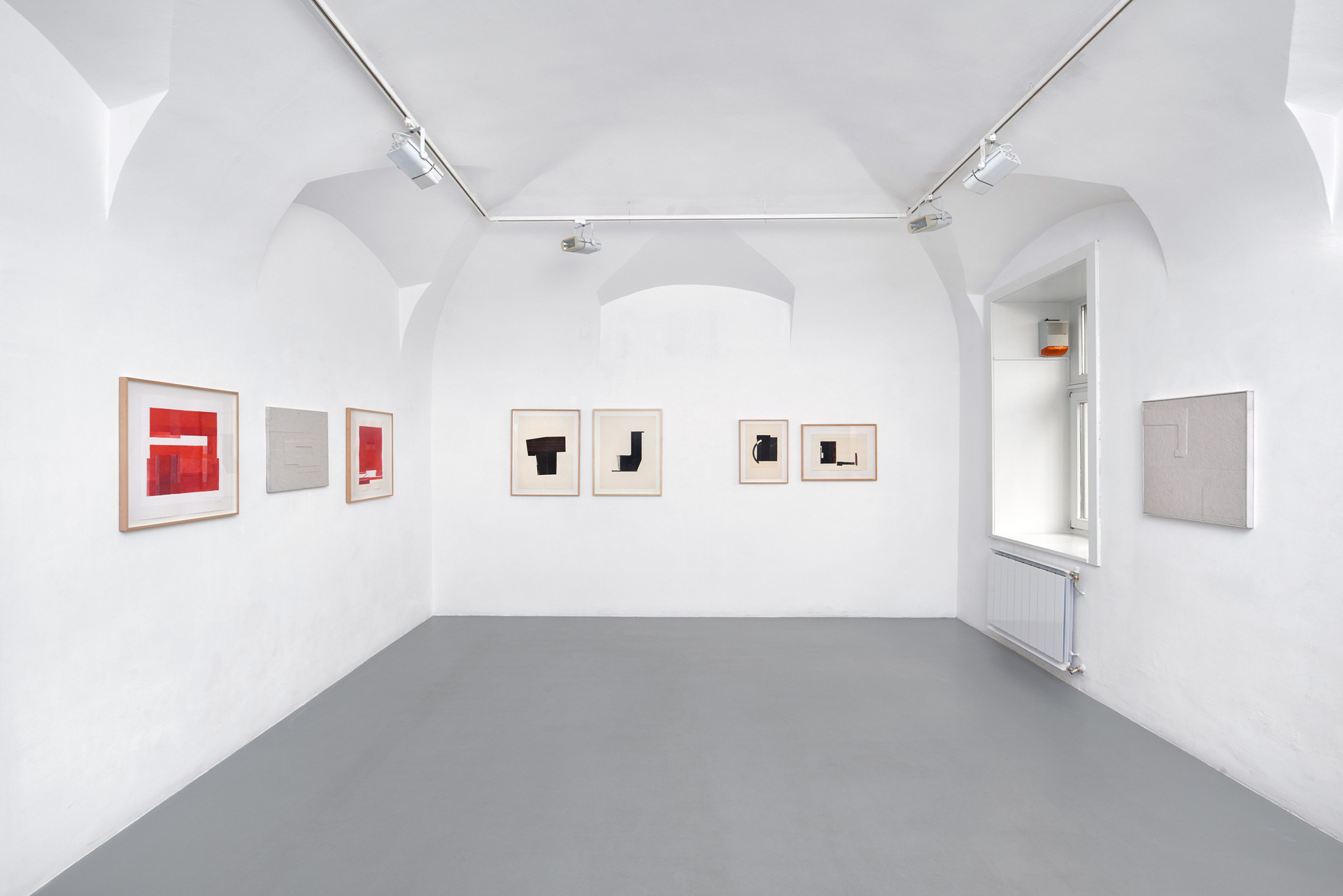
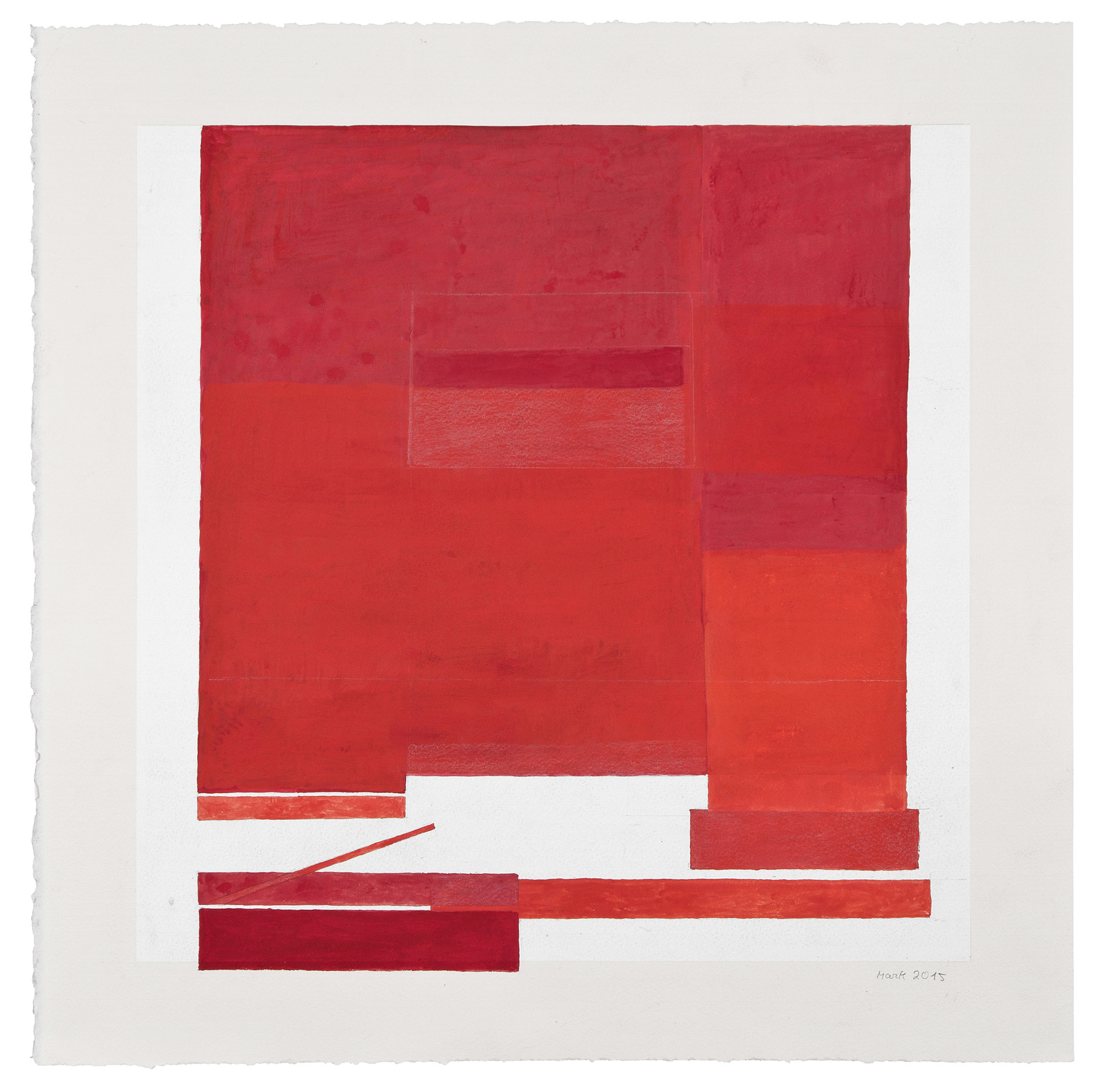
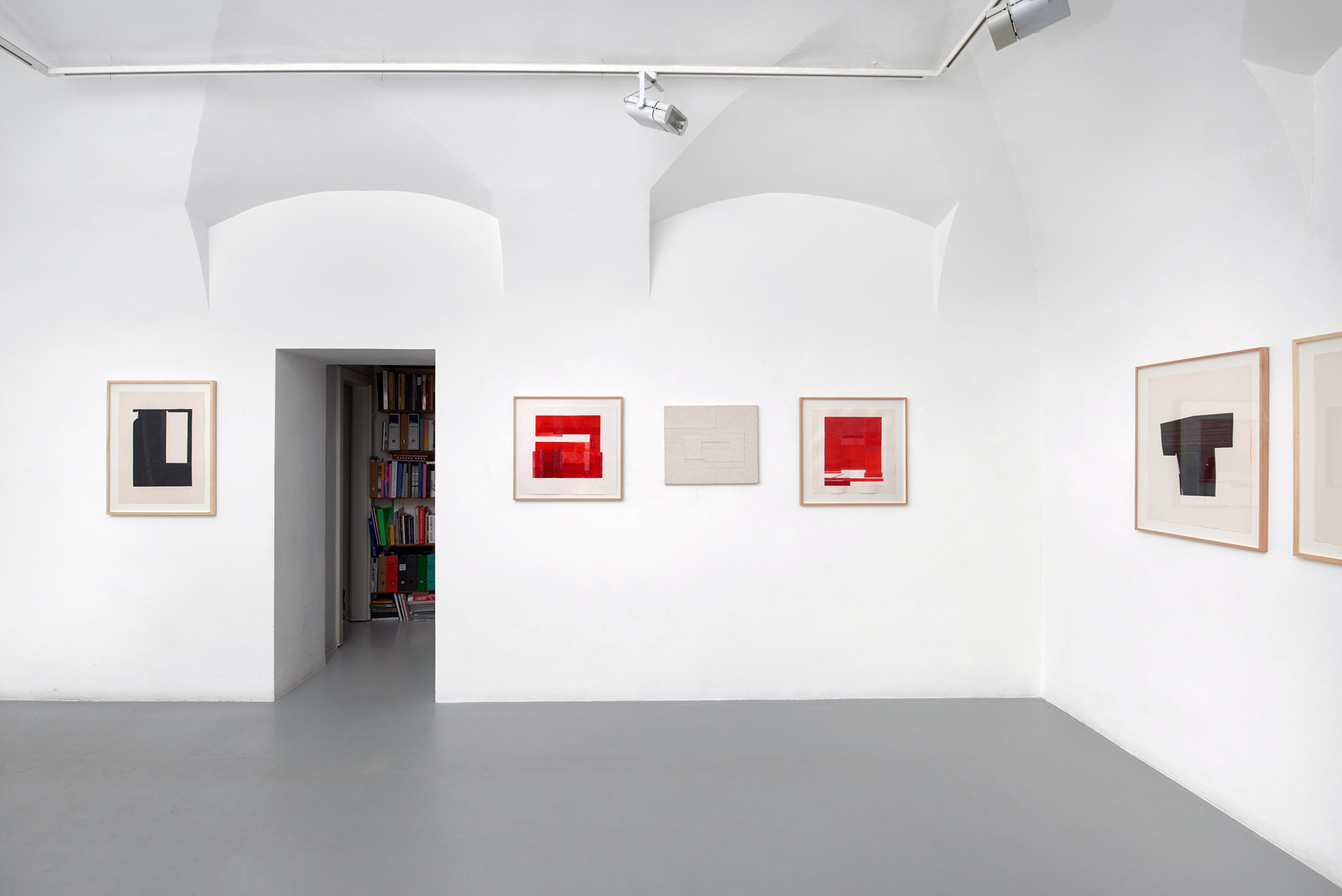
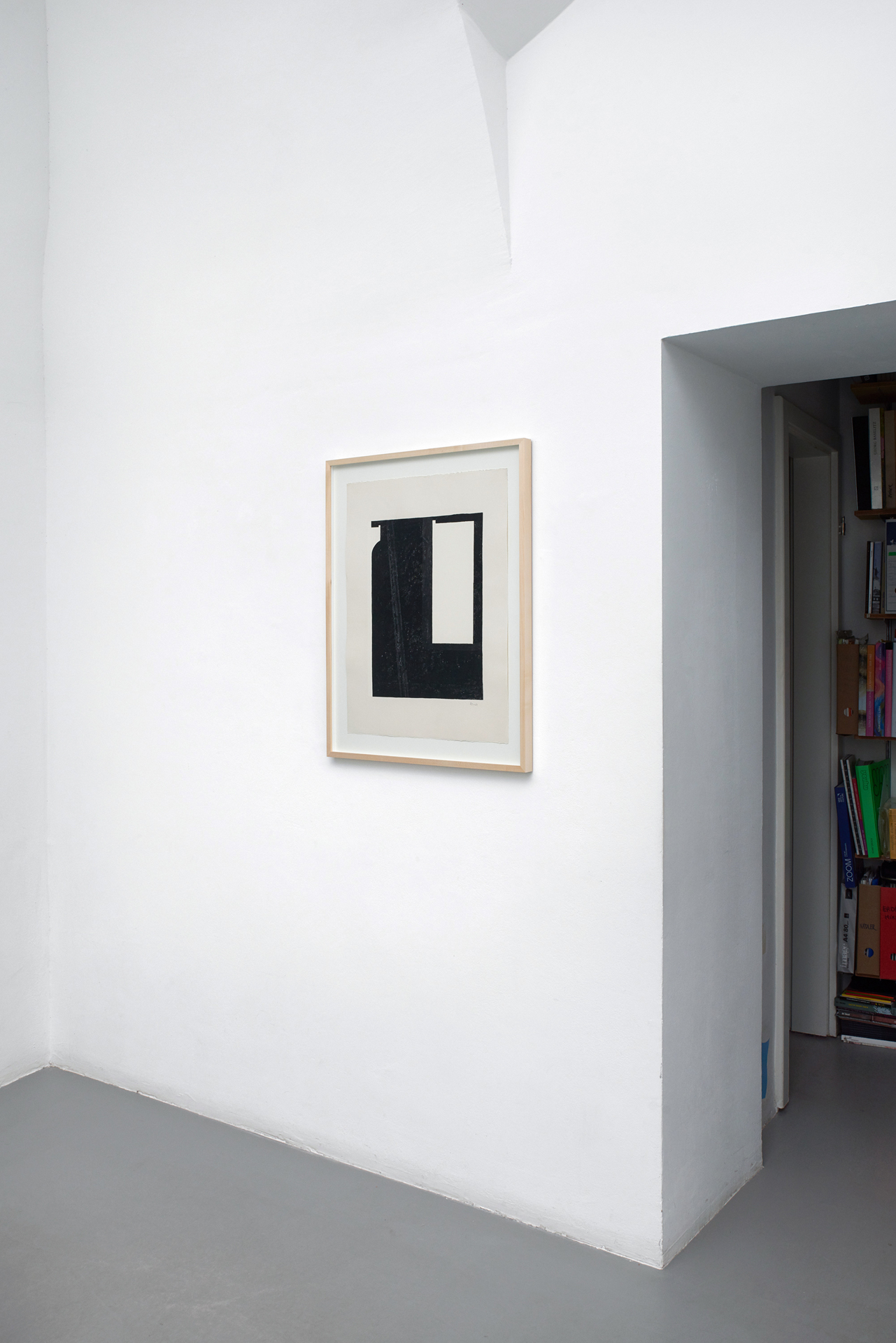
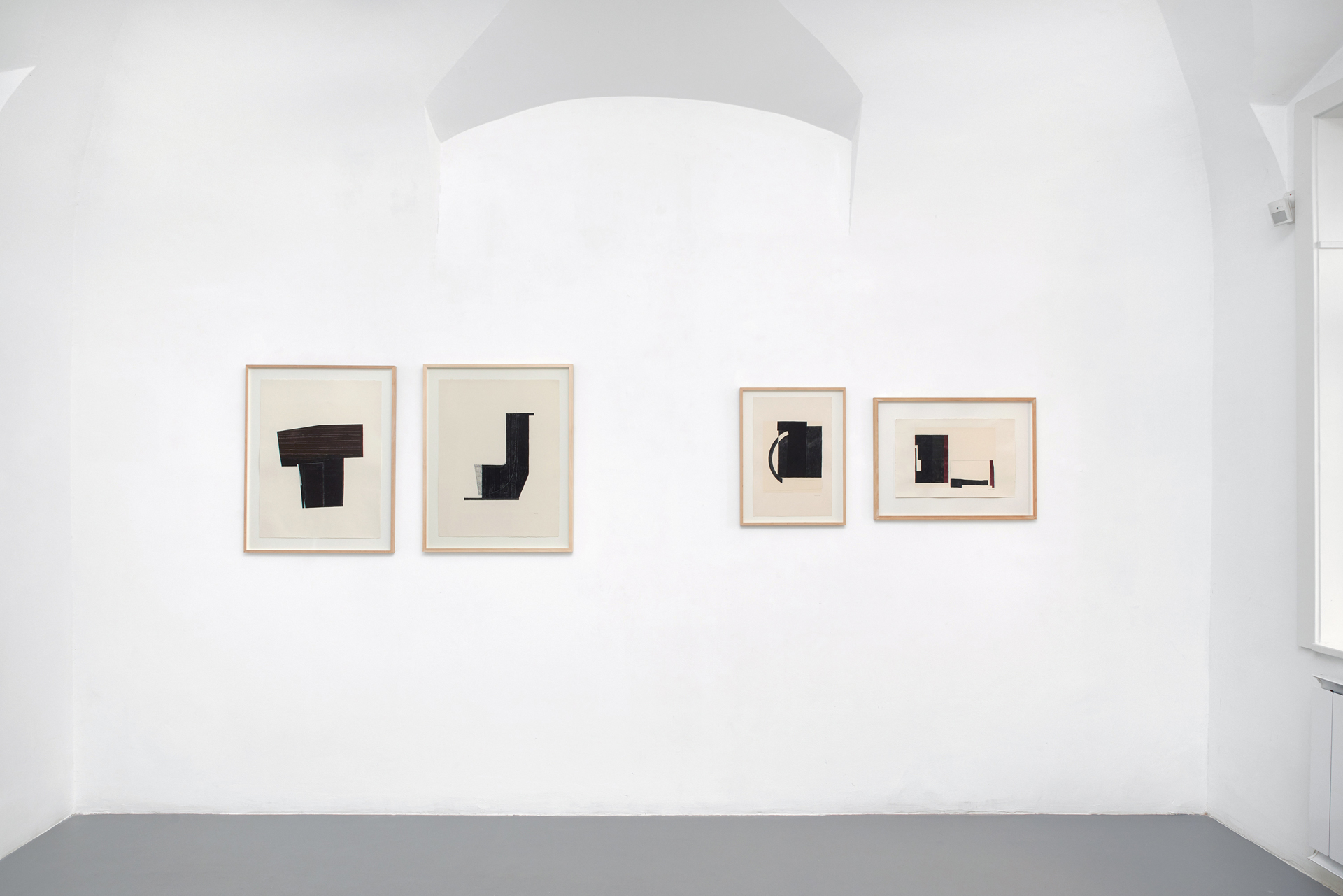
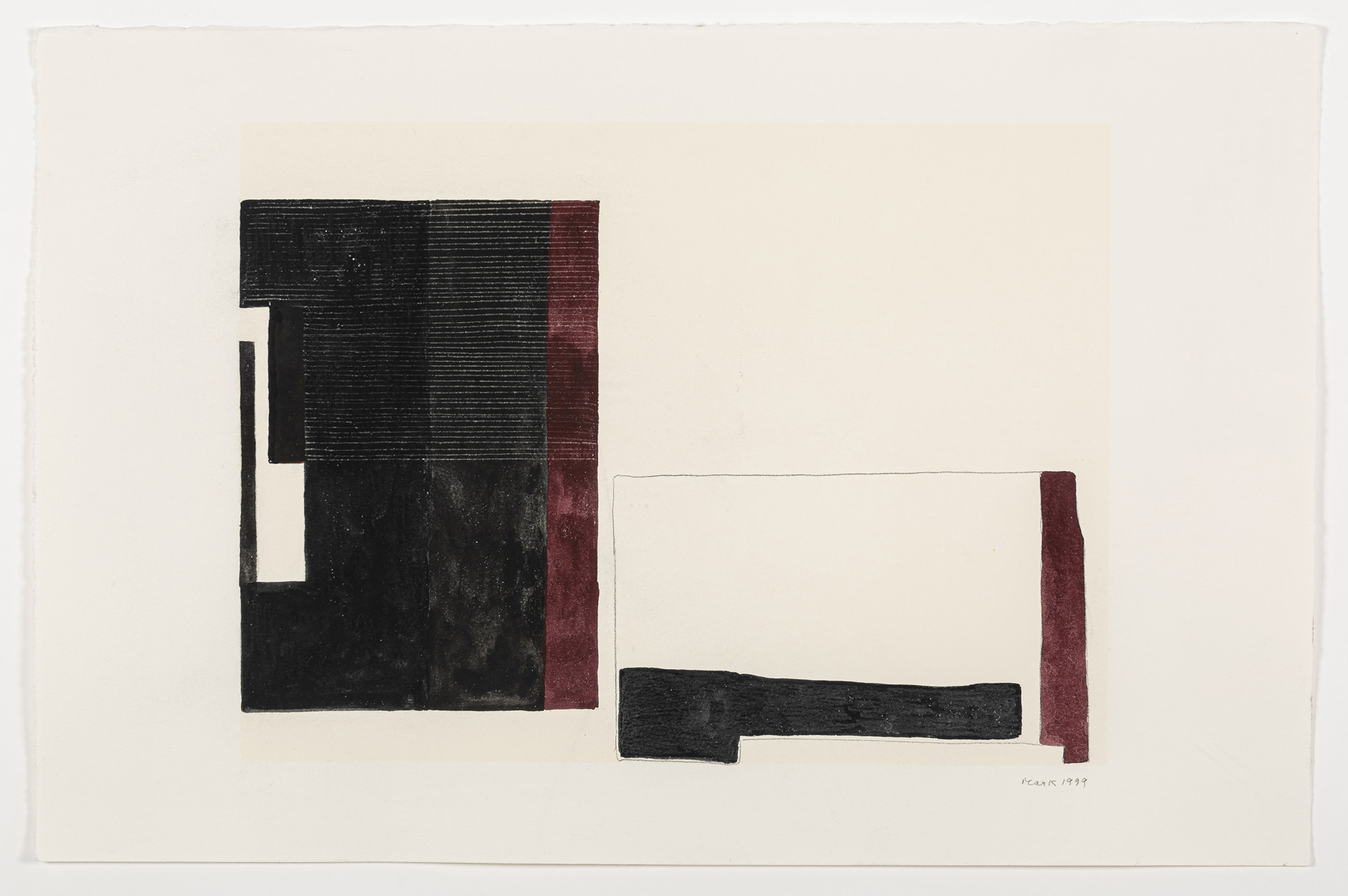
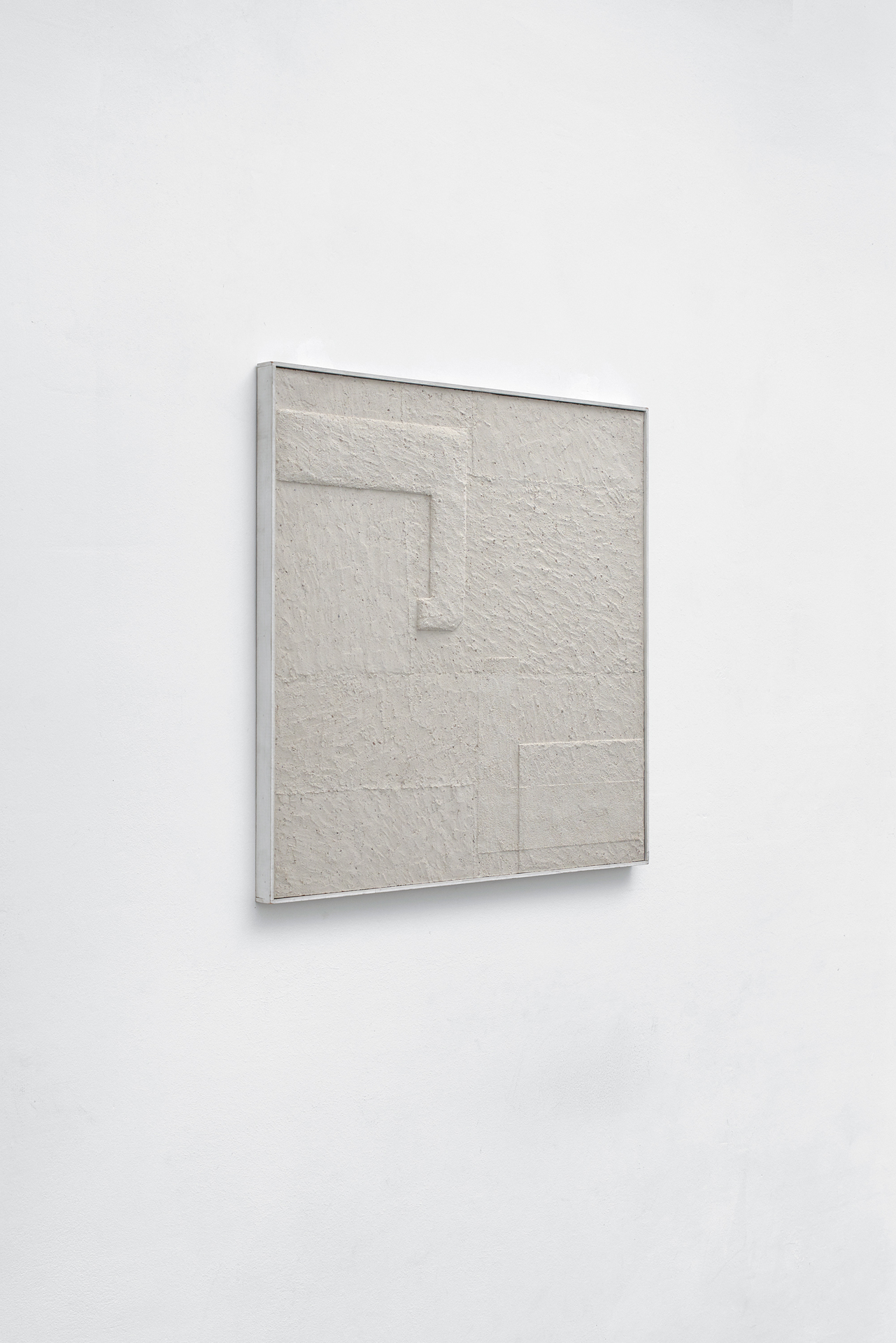
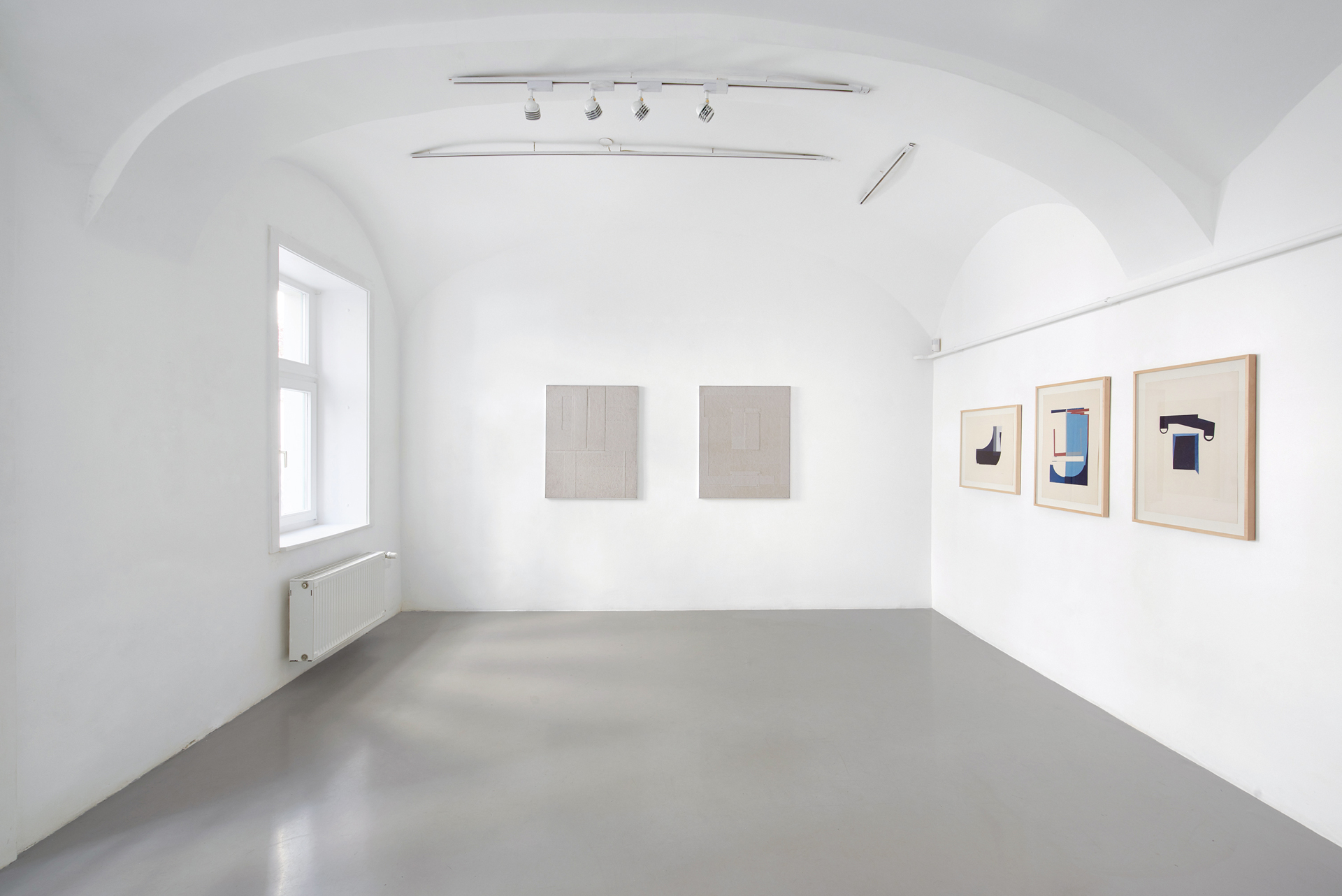
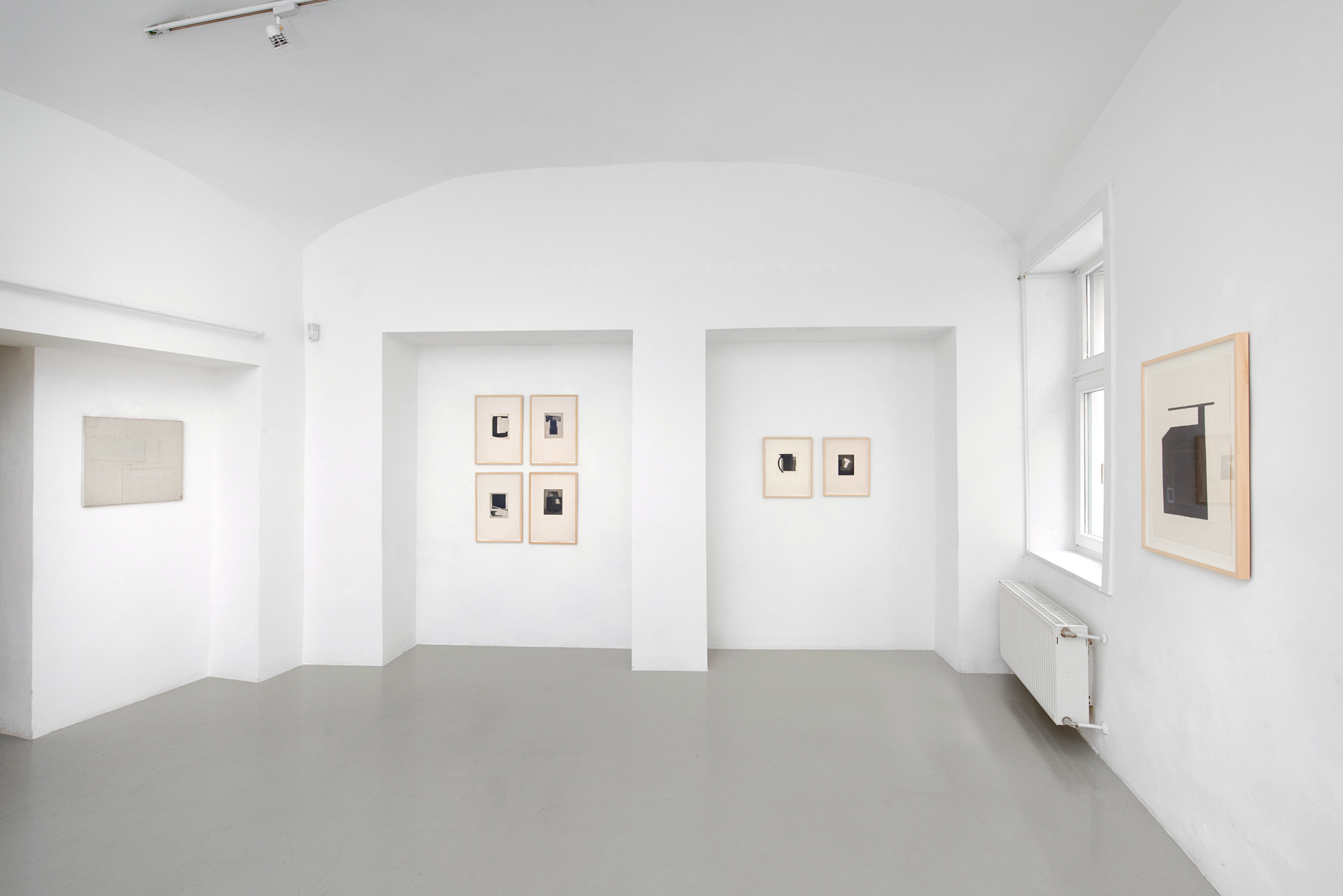
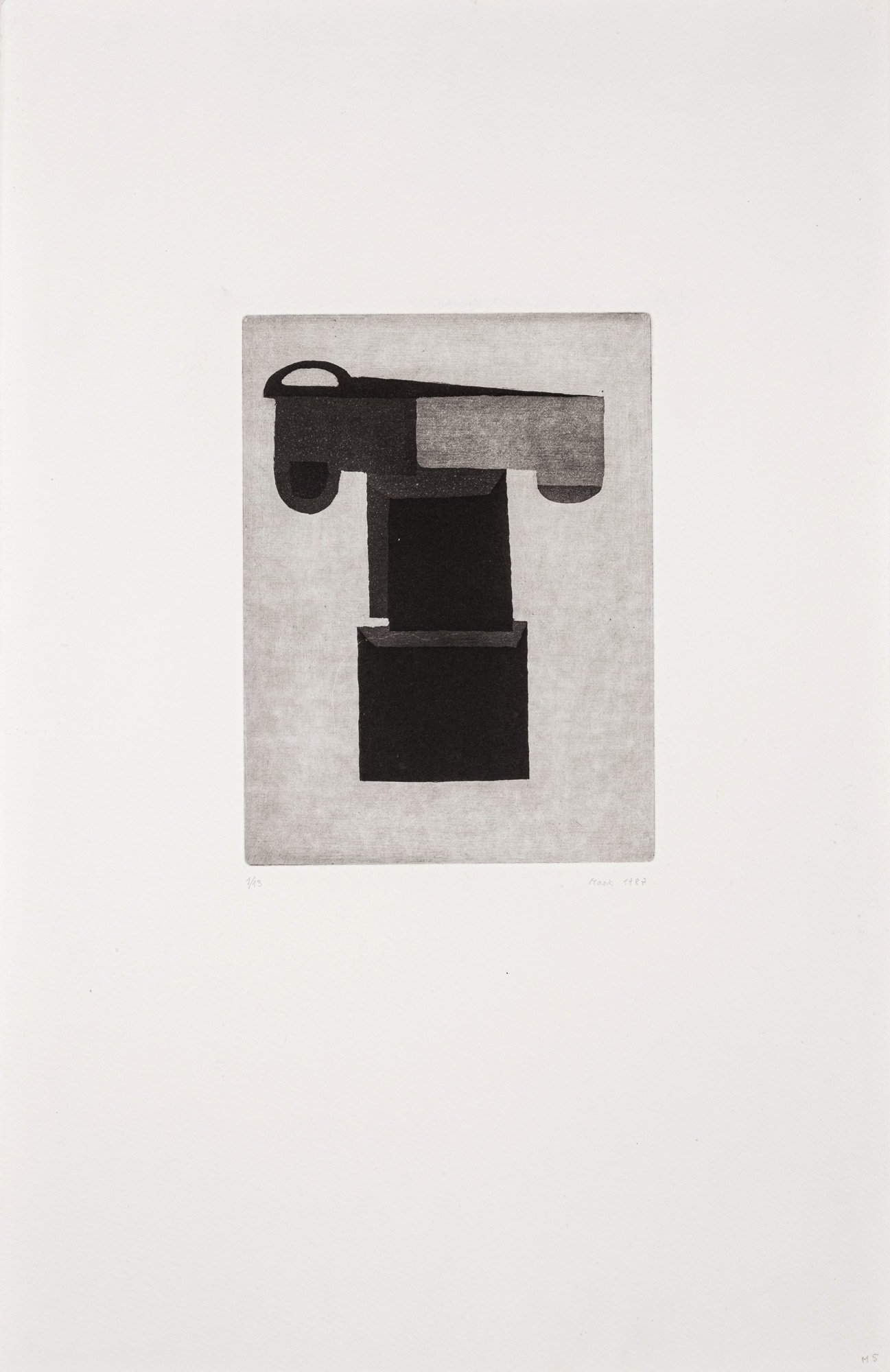
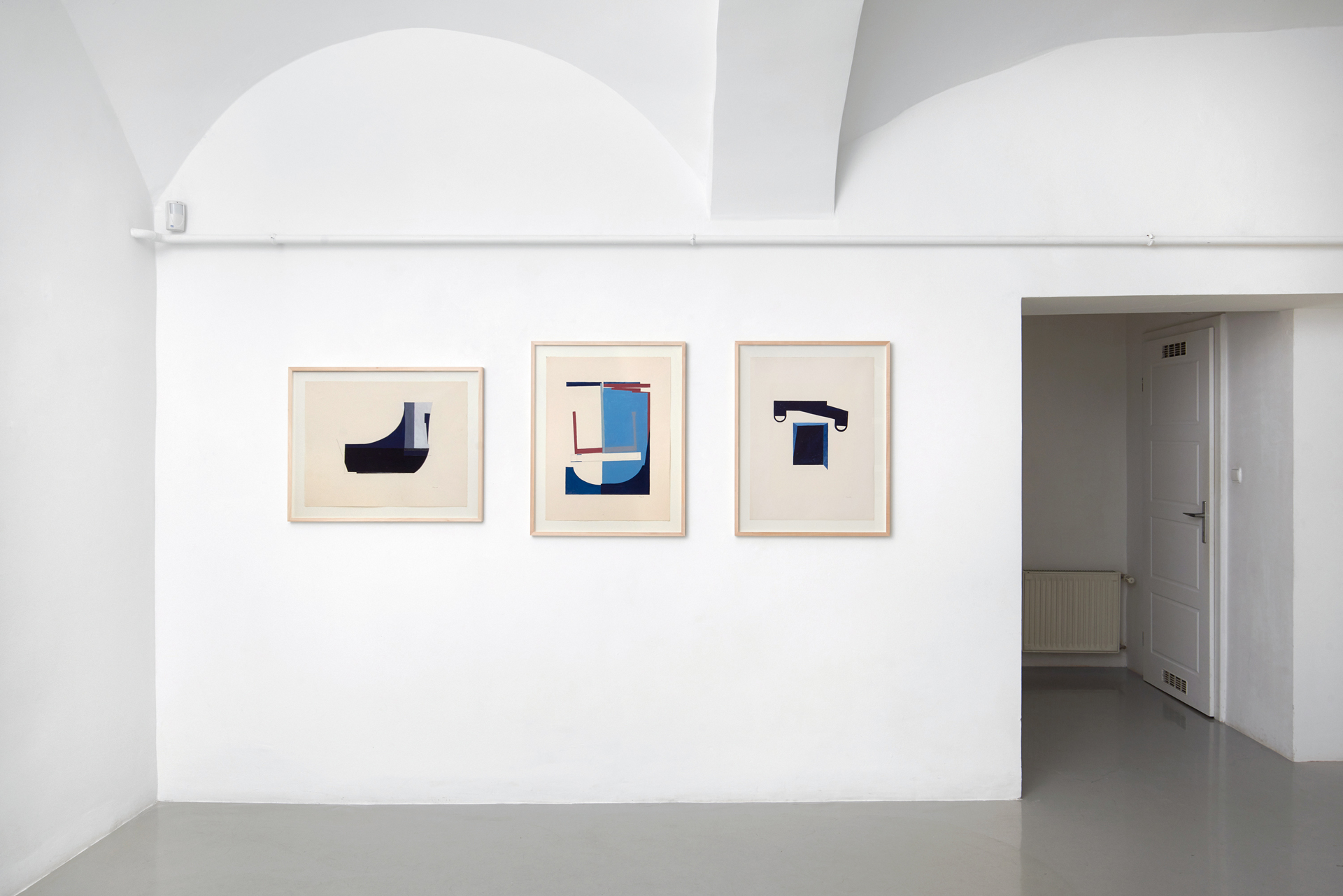
Anna Mark’s second exhibition at Kisterem focuses on the Paris-based artist’s works on paper from the 1980s and 1990s. In addition to her monochrome white reliefs, a large part of the artist’s oeuvre consists of her gouache series, in which she explored the possibilities of colour combinations, hues and compositions. Mark also worked on the motifs of these paintings through silkscreens and aquatints, a small selection of the latter of which will also be on show in the forthcoming exhibition.
Curated by Mária Árvai art historian, head of the Graphic Art Collection of Kiscelli Museum – Municipal Gallery
On Anna Mark
I recently spoke with Anna Mark, or rather Anna Márkus – on Skype. I noticed that a new sketchbook was now tucked away among the jumble of brushes and pencils on her desk. At my request, Anna flipped through it, and as her fingers turned the pages, I caught a fleeting glimpse of the emerging shapes of a new world of drawings taking form. I think that on that afternoon, I caught a glimpse of the graphic signs of a realm yet to come, but familiar in many ways from times past: the black lines were stretched across the white plane of the paper by some new force—the courage born of newly found freedom; the decisive curves and momentum of the thick lines, and the unambiguous power of things, events, or latent intuitions, came toward me, radiating through those short Skype recordings. I understood: Anna had reached the threshold of a new era. We can all rejoice that she has crossed this threshold with both caution and boldness: true to the old habits of a renewed artist, she tirelessly, carefully, and resolutely follows the path marked out by new ideas, new inner landscapes, and fresh sights that suddenly reveal themselves and are newly understood.
Of course, the current exhibition could not yet provide any information about all of this. The works featured here were created during earlier periods of the artist’s career: the reliefs between 1988 and 1999, the prints between 1984 and 1996, and the two small red compositions – which are the most recent in time – in 2015. But Anna Mark’s periods are always intertwined – not just in our imagination, but in reality as well. They intertwine, much like the tendrils of the triple-ribbon motif winding their way through the filigree stone carvings of the Romanesque period; they cling to one another, building upon each other imperceptibly, like the stones and pillars of ancient architecture that support and uphold one another. We had already learned this two years ago, in 2022, at the major exhibition in Szentendre showcasing Anna Mark’s body of work from 1959 onward. And we could see it at the same time at Kisterem, where a friendly dialogue unfolded between the paintings and reliefs hanging side by side peacefully on the walls. They all spoke of the same thing without interrupting one another. Here and there, the seemingly light lines embrace a weighty atmosphere. This invisible, intangible quality permeates her work – from her early surrealist paintings to her recent prints—and at times her colors almost “bleed” into the compositions. This “material” appears frequently even in her early works: in fact, it is the opaque void, at times merely a fleeting shadow or the benevolent veil covering things; as if we were seeing the immaculately cleansed and delicately refined details of memories sunk deep into the millennia, without the terrible weight of time bearing down on them—or on us. This is not the excavation of an archaeologist probing the earth with tools. The artist moves cautiously in the depths of the soul, almost on tiptoe, uncovering, discovering, and understanding, yet barely touching the fault lines of emotions and thoughts. Sensitivity and discipline. This duality is deeply characteristic of Anna Mark’s entire body of work: on the one hand, she opens up the surface of the painting to the space before it; on the other, she closes it off with few words, leaving the rest to the viewer’s imagination. Silent stillness, sparing words, while she moves with the gestures of a fallible acrobat through the dizzying dimensions of emptiness and depth. She knows this dangerous terrain well—the turmoil of inner events; the picture planes, trembling like a thin membrane, both hint at and conceal the infinity of a hidden world like a benevolent veil. She herself is wary of coming too close to some foreign secret without authorization. This is what gives her works their poignantly quiet inner tension.
She was a student of Róbert Berény at the College of Fine Arts; during the era of Socialist Realism, she found refuge at the Budapest Puppet Theater, where—in that puppet-scented nest—she discovered her friends, her peers, and her spiritual home in artistic nonconformity, alongside others such as Endre Bálint, Vera Bródy, Lili Ország.
When discussing Anna Mark’s art, her relationship with the European School always comes up. Of course, Anna could not have been a member of the group, primarily because of her age; yet her work is linked to its legacy by threads that are almost invisible, yet mysteriously strong and unbreakable. With her motifs, her spontaneity, her gestures that flit silently among the phenomena of the world, and her boldness that always teeters on the edge and fringes of things, she evokes the school’s aspirations. And indeed, at the European School exhibition that has just opened in Szentendre, the roots of her painting—sprouting from this very circle—are often evident. Anyone contemplating the room-sized spaces of the Kisterem—spaces so well-suited to Anna—will recognize here and there the shadows of handwritten codices and lines inscribed on parchment. Calligraphy, forms reminiscent of individual letters from hastily scrawled, ancient notes—these vivid graphic signs of shapes that have lost their meaning, emerging from the depths of time yet still alive—pulse before our eyes. They shift, waver, slip, and touch one another; and as their original meaning fades, it is precisely this cautious yet decisive wavering that breathes new life into them.
The aquatint prints from 1987 to 1996 particularly well illustrate how the painter treads on shifting ground and fragile ice as she works. The earlier exhibition in Szentendre, organized into chapters and interconnected periods, emphasized just how vital the line was to her – whether it was the edge separating one relief plane from another or the outline of a painting’s simple forms. It became clear that not only the vaguely defined inner “nothingness,” but also the sharp, decisive line – flowing effortlessly across the paper and moving purposefully among the forms – is of vital importance, defining the work in question. When we recall the precision and energy of Vajda’s drawings – which flow unimpeded and curve so expressively around forms – we are reminded of the sharp gaze of a sharpshooter and the power of a sure shot. Anna’s supple lines cut decisively and purposefully through planes or forms, or into the void opening between them. They are like a powerful, sharp, supple, and at times painful stroke. They carry the same precision and power as Vajda’s drawings. The foreword to the Szentendre catalog and the works featured in the exhibition may have been the first to draw attention to the fact that, from this perspective, Anna’s paintings preserve Lajos Vajda’s legacy as a hidden treasure.
Two years ago, here in front of Kisterem, on the narrow downtown street, two figures were talking quietly: Anna Mark, the elderly painter, and György Kurtág, the elderly composer. They were old friends who lived far apart and rarely saw each other. Now it was as if a magic circle had formed around them; people on the street carefully stepped aside to give them room. This invisible magic circle still hovers within the gallery’s walls, above Anna Mark’s compositions, and seems to be expanding as the light of a passing era, the legacy of an artistic movement, the sharp and tender twists of a way of thinking and seeing, the stirring simplicity of expression, and the vivid power of the drawings in the new sketchbook illuminate the details.
As Pilinszky wrote: “The sun has reached the edge of the paper”.
Márta Kovalovszky