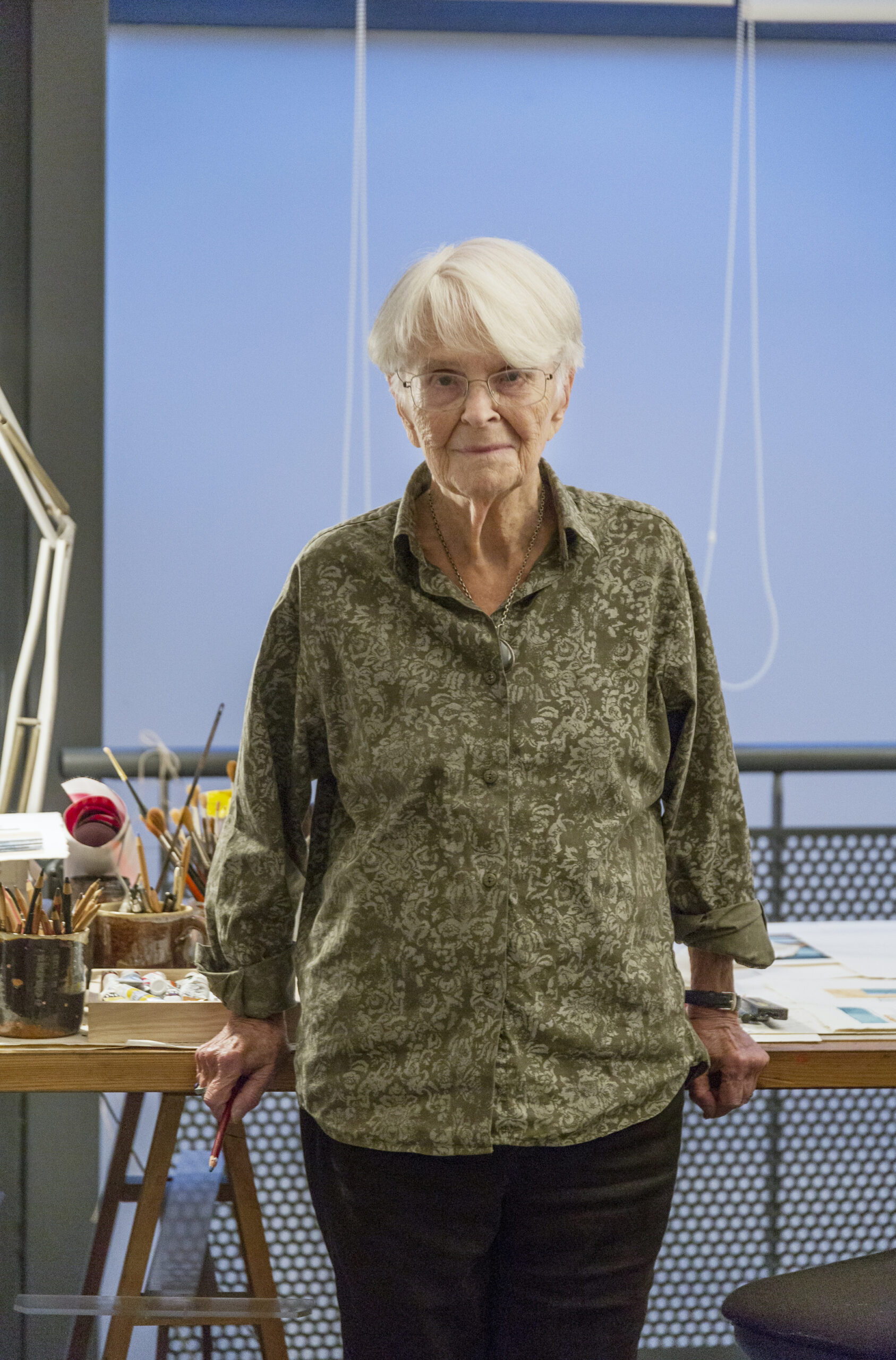
It is with great sorrow that we share the passing of Anna MARK, née Márkus Anna in Paris at the age of 97.
Anna Mark was a member of the generation of Hungarian painters that emerged after the Second World War and came to full artistic maturity in France. She was born in Budapest in 1928 into an intellectual family with close ties to Hungarian fine art and literary life. Between 1946 and 1950 she studied at the Hungarian Academy of Fine Arts in Budapest, and after graduating, she worked in the set-painting workshop of the State Puppet Theatre. She moved with ease among the circles of post-war Hungarian avant-garde artists, particularly those associated with the European School, and the early phase of her career was strongly shaped by Surrealism. Following the suppression of the 1956 revolution, she left the country and settled in Paris in 1959, where she worked until her death. From 1964 onward she held dozens of solo exhibitions in French galleries and remained an active participant in both the French and Hungarian art scenes throughout her life.
Initially figurative and Surrealist in character, inspired by Hungary in the 1950s, her painting underwent a transformation in Paris. Her oil-on-canvas works turned toward constructive composition and lyrical abstraction. By the late 1960s she discovered a new form and technique—the relief—which helped her fully unfold her own artistic path. At first she applied commercially available materials to canvas; later she developed her own fast-drying mixture of sand, synthetic resin, and marble dust, which she spread onto fiberboard. By the late 1970s her abstract visual world had taken shape, and from the 1980s onward her reliefs became monochrome, working primarily in white or black. She also pursued graphic art; her unique drawings were created on silkscreen-print bases using gouache, chalk, and pencil.
Her reliefs are characterized by duality: she employed both painterly and sculptural means, so abstraction and materiality are simultaneously present in the works. For her, abstraction was not a chosen style but a creative method that allowed her to break away from the literary, narrative-driven tendencies of Hungarian art. In her images, surfaces bounded by lines outline abstracted forms of motifs. The sources of her motifs can be found partly in Eastern European folk art, folk music, and the built environment. Like the world-renowned composer and folk-song collector Béla Bartók, her art drew on folk art as an original source. Her aim was similar as well: she did not seek to imitate or reinterpret folk art, but to understand it deeply and, starting from it, create something different—something new, modern art.
Her interest in and admiration for folk art began in her youth and is connected to her travels in Transylvania. Later she assembled her own folk art collection; utilitarian objects of peasant culture surrounded her in her home, bearing the marks of time and carrying their own histories in their wear and damage. Mark incorporated these once-everyday, use-oriented objects into her artistic world, where they subtly emerge in the reliefs. The house, the archetype of home, and the memory of places important to her also recur in her works. The layering and uncovering of surfaces resembles excavation, an archaeological investigation.
“The same, but differently.” This is a fundamental issue in Anna Mark’s art. She worked with simple objects and motifs, yet always sought to resolve her images in different ways. There was no single good or final solution; her motifs and themes returned, but the painterly or sculptural solutions—colors, placement, tones, patterns, the movement of lines, the roughness of surfaces—were constantly changing. The act of remembering and recalling is close to the way Anna Mark worked. A memory is always different each time we summon it; our present moment is always embedded in it. Human figures never appear in her reliefs, yet their traces are constantly present.
Her warm colors, fine, confident yet fragile lines, and varied, flickering, granular surfaces can be approached through sensuality, while the appearance of the concept of time—in shadows, layers, and traces—engages our intellect. In the small details and deliberate irregularities we can also perceive playfulness and humor.
Mária Árvai
Anna Mark’s oeuvre has received continuous attention; in recent years exhibitions of her work have been held in Budapest, Szentendre, and Paris. Her works are held by renowned French, Hungarian, and Swiss institutions and private collections. In 2025, the Museum of Fine Arts in Budapest acquired some of her early drawings, and the Musée des Beaux-Arts in Rouen added to its collection a selection of her reliefs, paintings, artist’s books, and drawings. In 2026, the Rouen museum will host a major retrospective exhibition of Anna Mark’s works.